Screamzonetattoo
Tattoo sahi hai !

screamzonetattoo@gmail.com

Lord Krishna Tattoo: Meaning, Designs, Placement, and What to Know Before Getting One

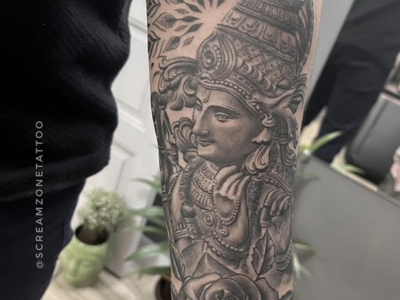
Lord Krishna Tattoo Meaning: The Symbolism Behind the Imagery Krishna’s iconography is some of the most visually distinct in Hindu tradition. Every element carries meaning. Understanding what you’re including in your design changes the relationship you have with the tattoo. The Flute (Bansuri) The flute is Krishna’s most recognizable attribute. The music represents divine consciousness calling the soul toward itself — the sound that draws Radha and the gopis away from ordinary life toward something beyond it. In tattoo form, the flute appears in almost every Krishna design. A standalone flute tattoo is one of the cleaner minimalist options for people who want a Krishna connection without a full portrait. Peacock Feather (Mor Pankh) The peacock feather in Krishna’s crown is one of the most iconic symbols in Indian iconography. It represents beauty, grace, and the divine play (leela) of existence. In tattoo form, the peacock feather is versatile — works as a standalone piece, as a crown detail in a portrait, or as a complementary element in a Radha-Krishna composition. Makhan (Butter) — Bal Krishna The image of young Krishna stealing butter — Makhan Chor — is one of the most beloved forms in Indian devotion. It represents innocence, mischief, and the idea that the divine doesn’t operate by ordinary rules. As a tattoo, Bal Krishna is among the most emotionally resonant choices, particularly for people who grew up with this imagery. Sudarshana Chakra The spinning discus weapon held on Krishna’s finger. Represents cosmic order, the destruction of evil, and divine protection. In tattoo form, the chakra appears most commonly in Vishwaroopa or warrior depictions of Krishna. It’s a strong design element that adds dynamism to any composition. Radha Krishna The Radha-Krishna pairing is not simply a love story. It represents the soul’s longing for the divine — Radha as the devotee, Krishna as the object of devotion, the gap between them as the space of spiritual seeking. As a tattoo, Radha-Krishna is one of the most requested couple or devotional designs in India. Arjuna and Krishna — Bhagavad Gita Scene Krishna as the charioteer, Arjuna in the chariot, the battlefield of Kurukshetra as the backdrop. This is one of the most philosophically charged images in Hindu tradition — the moment the Gita was spoken. As a tattoo, this is a large-scale composition that requires a skilled artist and significant space. It’s not a wrist tattoo. Peacock, Cow, Yamuna River These are supporting symbols — the cow representing abundance and care (Krishna as Govinda, protector of cows), the Yamuna as the sacred river of his childhood, and the peacock as his natural companion. These work as background or supporting elements in larger compositions. Lord Krishna Tattoo Designs: Forms and Compositions That Work 1. Krishna Portrait Tattoo A realistic portrait of Krishna — typically showing the flute, peacock feather crown, and the characteristic blue skin tone. This is the most demanding execution in the Krishna tattoo category. The facial expression matters enormously — Krishna’s expression is typically serene and slightly knowing, not fierce. An artist who can capture that subtlety in portraiture is not easy to find. Black and grey or color? Krishna portraits split here. The blue skin is iconically associated with Krishna, which makes color work a logical choice. However, black and grey portraits done with skill are often more timeless and hold better over years. Both are valid — the choice depends on artist strength and your aesthetic preference. Best placement: Chest, upper arm, back, thigh. Style: Black and grey realism, color realism. Critical factor: Artist’s portrait portfolio. Specifically check for deity work, not just general portraits. 2. Radha Krishna Tattoo The most requested Krishna design in India. The composition typically shows Krishna playing the flute, Radha beside him, often set against a Vrindavan background — lotus flowers, the Yamuna, or a full moonlit scene. As a couple tattoo, Radha-Krishna carries cultural depth that generic couple tattoo designs don’t. It’s also a design that works for individuals who connect with the devotional aspect of the imagery — not just couples. Best placement: Back, chest, upper arm, ribs. Style: Black and grey realism, illustrative, traditional Indian. 3. Bal Krishna Tattoo (Child Krishna) Young Krishna — crawling, holding a ball of butter, or dancing. The expression is key: playful, innocent, and alive. This form is particularly meaningful for parents tattooing imagery connected to childhood and joy, or for devotees of the Vallabhacharya or Pushti Marg traditions where Bal Krishna is central. Best placement: Upper arm, calf, back. Style: Illustrative, black and grey realism, fine line. 4. Krishna with Flute (Standing/Tribhanga Pose) The classic standing pose — weight on one hip, flute to the lips, peacock feather in the crown. This is the most compositionally complete single-figure Krishna image. The tribhanga (three-bend) posture gives the figure natural elegance and movement. Works at medium to large scale. Best placement: Upper arm, calf, back. Style: Black and grey realism, illustrative, neo-traditional. 5. Bhagavad Gita / Kurukshetra Scene Tattoo Krishna and Arjuna on the chariot, the battlefield in the background, the moment the Gita begins. This is a full-scene composition — not suitable for small formats. The level of detail required demands an artist with experience in narrative or multi-figure compositions. Best placement: Full back, chest piece, thigh. Style: Black and grey realism, illustrative. 6. Vishwaroopa Tattoo The cosmic form of Krishna — the moment he reveals his universal form to Arjuna. One of the most visually dramatic moments in the Mahabharata. As a tattoo, this is ambitious work. When executed well, it’s extraordinary. It requires both the right artist and significant real estate on the body. Best placement: Full back, chest to abdomen. Style: Black and grey realism, illustrative. 7. Minimalist Krishna Tattoos For people who want a Krishna connection without a full portrait or scene: Flute (bansuri) tattoo — standalone, clean, immediately associated with Krishna Peacock feather tattoo — elegant, works at small to medium scale Om with flute — combines the universal symbol with Krishna’s specific attribute Lotus with

Lord Krishna Tattoo: Meaning, Designs, Placement, and What to Know Before Getting One Read More »

Couple Tattoo in India: Designs, Meaning, Placement, and What to Actually Know Before Getting One

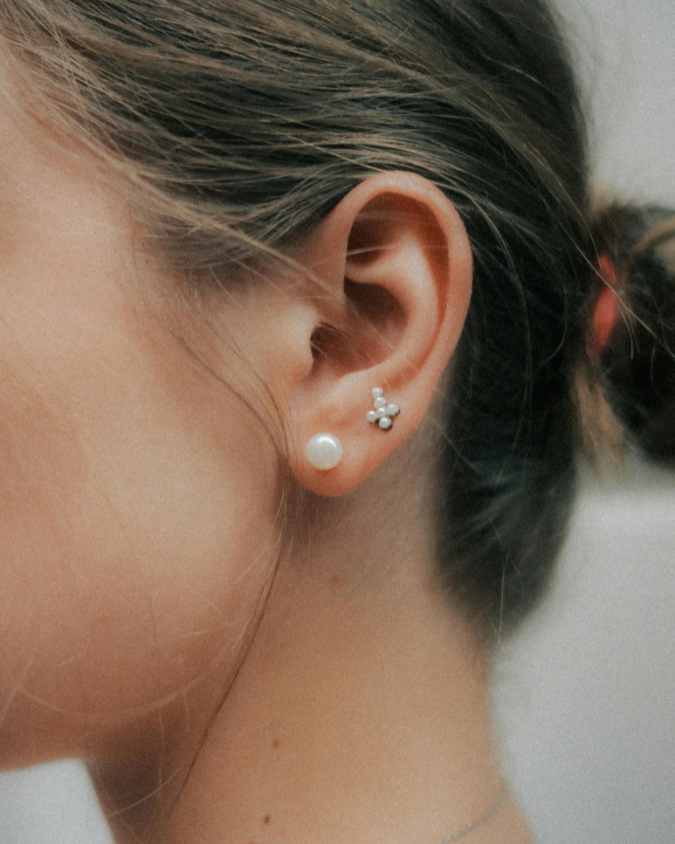
Why Couple Tattoos Are Different From Every Other Tattoo Decision Most tattoos are personal. A couple tattoo involves two people, two pain thresholds, two opinions on design, and a shared decision that stays on both of you permanently. That’s a different kind of commitment than just deciding you want a sleeve. In India, couple tattoos have grown significantly over the last decade — and the reasons are varied. Some people get them as a relationship milestone. Some do it for the shared experience. Some genuinely love the imagery. And some, honestly, do it in a rush of emotion and regret it when the relationship doesn’t outlast the ink. This guide is not here to talk you into or out of it. It’s here to give you accurate information — what designs work, what doesn’t hold up over time, what questions to ask your artist, and how to approach this as a considered decision rather than a spontaneous one. What Is a Couple Tattoo: Understanding the Concept Properly A couple tattoo doesn’t always mean matching tattoos. That’s a common misconception. There are broadly three categories: Matching tattoos: Both people get the exact same design — same symbol, same placement, same size. A lock on both wrists, an identical wave, the same constellation. Complementary tattoos: Two separate designs that are incomplete without each other. The classic example is a lock and key — one person gets the lock, the other gets the key. A sun and moon. A king and queen chess piece. These only “work” when the two people are together. Coordinated tattoos: Similar theme, different execution. Same flower, different variety. Same script style, different words. A loose connection rather than a tight pair. This is actually the most versatile option because each person still has something individual. Understanding which type fits you and your partner is the first real decision to make — before you even open Instagram for design references. Couple Tattoo Designs in India: What People Are Actually Getting Indian couples tend to go in specific directions. Here’s an honest look at what’s popular and what actually works as tattoo art: 1. Name Tattoos Still the most commonly requested couple tattoo in India. One person gets the other’s name — in English, Hindi, or Sanskrit script. This is also the most complicated recommendation to make. A name tattoo is a strong declaration, and when relationships end, it becomes one of the most requested cover-up jobs at every studio in the country. That’s not pessimism — that’s what tattoo artists see regularly. If you’re set on a name tattoo, at minimum choose a design where the name can be incorporated into a larger piece, making future cover-up or modification significantly easier if needed. Best execution: Incorporate the name into a design element — inside a banner, as part of a floral composition, or in a script style that doubles as art. Standalone names in a basic font have the least design value and the most cover-up risk. 2. Lock and Key Tattoos One of the most enduring complementary designs. Works because both pieces are visually interesting on their own, and the connection only becomes obvious when the two people are together. The lock and key concept also translates well across different styles — illustrative, fine line, blackwork, neo-traditional. Best placement: Wrist, inner forearm, ankle. Style: Fine line, illustrative, blackwork. 3. Sun and Moon Tattoos The sun and moon pairing represents balance — two forces that are different but complementary. In India, this carries additional resonance given the cultural significance of Surya and Chandra in mythology. As a design, it’s versatile — can be done minimally or elaborately. Best placement: Wrist, back of the arm, ankle, collarbone. Style: Fine line, geometric, dotwork, illustrative. 4. Fingerprint Heart Tattoo A heart formed from two overlapping fingerprints — one from each person. Conceptually strong because it’s literally unique to the two of you. No two fingerprint heart tattoos in the world are identical. The execution requires an artist who works with precision on small-scale detail. Done well, it’s one of the more meaningful couple tattoo concepts. Done poorly, it’s unreadable. Best placement: Wrist, inner arm, collarbone. Style: Fine line, realistic detail. 5. Coordinates Tattoo The GPS coordinates of a place significant to the couple — where they met, first date, wedding location. Clean, subtle, and personal without being overtly romantic. Works well for people who want a couple tattoo that doesn’t immediately read as one. Best placement: Forearm, collarbone, ribs. Style: Fine line, simple script. 6. Infinity Symbol Tattoos Overused — let’s be honest. The infinity symbol is perhaps the most common couple tattoo in India and globally. If it genuinely means something to you, get it. But from a design standpoint, it’s been done so many times that it carries very little visual distinctiveness. If you’re going in this direction, at least have your artist incorporate something personal into the design. 7. King and Queen Tattoos Chess piece crowns — king on one person, queen on the other. Popular in urban India, particularly among younger couples. Clean graphic design that works at small or medium scale. Best placement: Wrist, finger, back of neck. Style: Blackwork, fine line, geometric. 8. Matching Constellation Tattoos Birth star signs or a specific constellation that means something to the couple. Works well in a minimalist fine-line style. Subtle enough to not immediately announce itself as a couple tattoo while still being connected. Best placement: Wrist, collarbone, inner arm, ankle. Style: Fine line, dotwork. 9. Mythological Pairs In India specifically, there’s a rich source of inspiration here — Shiva and Parvati, Ram and Sita, Radha and Krishna. These designs carry cultural weight that goes beyond the relationship. They’re also compositionally more complex, which means more opportunity for strong artwork. Best placement: Upper arm, back, chest, ribs. Style: Black and grey realism, illustrative, traditional Indian. 10. Abstract or Geometric Matching Designs Two halves of a geometric shape, an abstract pattern that connects, or a mandala split across two

Couple Tattoo in India: Designs, Meaning, Placement, and What to Actually Know Before Getting One Read More »

Lord Shiva Tattoo: Meaning, Designs, and Everything You Should Know Before Getting One

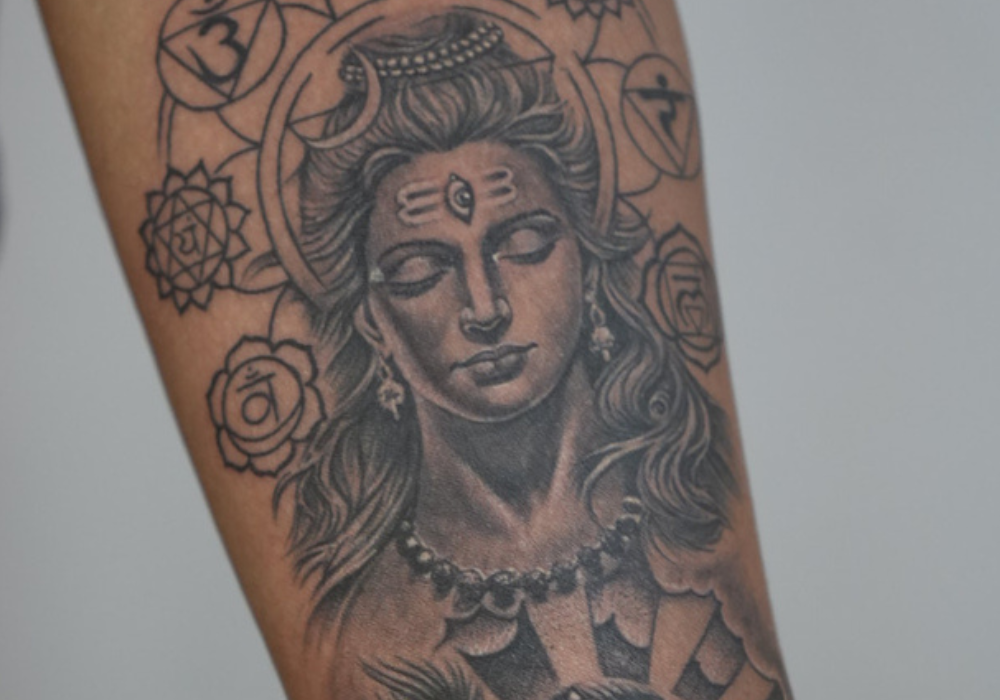
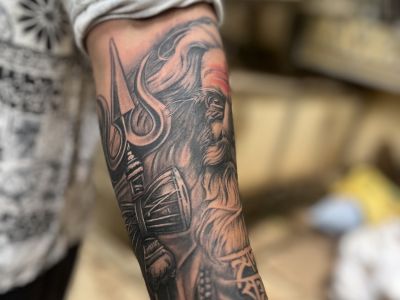
What Makes a Lord Shiva Tattoo Different From Any Other Tattoo Most tattoos are decorative. A Shiva tattoo usually isn’t.   People who get Mahadev inked aren’t doing it because it looks cool on a mood board. They’re doing it because something in that imagery speaks to them — destruction, rebirth, the untamed side of existence. Shiva is not a gentle deity. He’s the one who burns what needs to burn so something real can emerge. That’s a heavy thing to carry on your skin, and that’s exactly why people want it. This guide covers everything — the meaning behind different Shiva symbols, which design works for which body placement, what style fits the imagery best, what questions to ask your artist, and how to avoid the mistakes that make a great concept end up as a mediocre tattoo. Lord Shiva Tattoo Meaning: Understanding What You’re Actually Getting Before you settle on a design, understand what the symbols mean. Shiva is a complex figure — he holds contradictions together. He’s a yogi and a destroyer. He’s associated with death and also with consciousness. Getting a Shiva tattoo without understanding this is like wearing a word in a language you don’t speak. Here are the core symbols and what they represent: Trishul (Trident) The trishul represents the three fundamental forces — creation, preservation, and destruction. It’s also associated with past, present, and future. As a tattoo, it’s one of the most versatile Shiva symbols — works standalone, works inside a larger portrait, works as a forearm piece or spine tattoo. The trishul is also the most commonly tattooed Shiva symbol in India. Third Eye Shiva’s third eye, located between the eyebrows, represents higher consciousness and the power to see beyond illusion. When it opens, it burns. That’s both a literal concept in the mythology and a metaphor worth sitting with. As a tattoo design, the third eye works brilliantly in portrait work — when an artist nails the intensity around that area, the whole piece comes alive. Damaru (Drum) The damaru is tied to creation — sound as the origin of existence. Shiva’s cosmic dance, the Tandava, happens to the rhythm of the damaru. It’s a less common tattoo choice, but when incorporated into a portrait or scene, it adds serious depth. Crescent Moon The crescent moon on Shiva’s head represents time — specifically the idea that Shiva is beyond it. It’s also linked to Soma, the nectar of immortality. In tattoo designs, the moon adds elegance and contrast, especially in black and grey work. Snake (Vasuki) The serpent around Shiva’s neck isn’t a threat — it’s a symbol of ego subdued. Shiva wears death as an ornament. The snake as a design element wraps beautifully around limb tattoos, and in portrait work, it adds a dramatic visual frame. Vibhuti (Sacred Ash) Three horizontal ash lines on Shiva’s forehead. In tattoo form, these are usually part of a portrait but can also be done as a standalone minimalist piece. Ganga The river Ganga flows from Shiva’s matted hair. This represents Shiva as the one who absorbs what would otherwise destroy — he held the force of Ganga’s descent so the earth wouldn’t be destroyed. In full-scene compositions, this is a striking element to include. Lord Shiva Tattoo Designs: What Works and What Doesn’t There are hundreds of Shiva tattoo variations. Here’s how to think about them by category: 1. Shiva Portrait Tattoo This is the most powerful execution when done well — and the most damaging when done poorly. A Shiva portrait demands an artist with genuine skill in black and grey realism or fine line portraiture. The details that make or break it: the matted locks (jata), the intensity around the eyes, the third eye, and the expression — calm but not passive. Best placement: Upper arm, chest, back, thigh. Style: Black and grey realism, dotwork. Common mistake: Choosing an artist who can’t handle fine facial detail. Always check their existing portrait work before committing. 2. Mahadev Meditating Tattoo Shiva in deep meditation — seated, eyes closed, Himalayas often in the background. This composition is more contemplative than dramatic. It works for people who connect with the yogi aspect of Shiva more than the destroyer aspect. Best placement: Back, chest, calf. Style: Illustrative, dotwork, geometric. 3. Trishul Tattoo (Standalone) Clean, graphic, and immediately recognizable. A trishul tattoo can be done minimally — just the silhouette — or with elaborate detail including flames, serpents, or a damaru at the base. It’s a versatile design that scales well across sizes. Best placement: Forearm, spine, sternum, back of the neck. Style: Fine line, geometric, bold blackwork. 4. Ardhanarishvara Tattoo Half Shiva, half Parvati — the divine masculine and feminine unified. This is a less common choice but deeply meaningful for people who understand the concept. Compositionally, it’s one of the most interesting Shiva designs because it demands balance in the artwork itself. Best placement: Chest, back, ribs. Style: Illustrative, traditional Indian, fine line. 5. Nataraja (Cosmic Dance) Tattoo Shiva as the lord of dance — standing in the ring of fire, performing the Tandava. This is a full-composition design and works best as a large piece. The circular frame, the posture, the fire — when executed with precision, it’s one of the most striking religious tattoos possible. Best placement: Back, chest, upper arm. Style: Geometric, illustrative, linework. 6. Om Namah Shivaya Script Tattoo The mantra as a standalone piece. Can be done in Devanagari or Sanskrit lettering. Works well combined with other Shiva symbols like the trishul or Om symbol. Straightforward in concept, but the quality of the lettering work matters more than most people realize. Best placement: Forearm, collarbone, ribs. Style: Fine line, traditional script. Shiva Tattoo Placement Guide Placement affects everything — visibility, how the design breathes, how it ages, and how it interacts with your body’s natural lines. Design Best Placement Reasoning Portrait Chest, upper arm, back Needs flat, stable canvas for detail Trishul Forearm, spine, sternum Linear design,

Lord Shiva Tattoo: Meaning, Designs, and Everything You Should Know Before Getting One Read More »