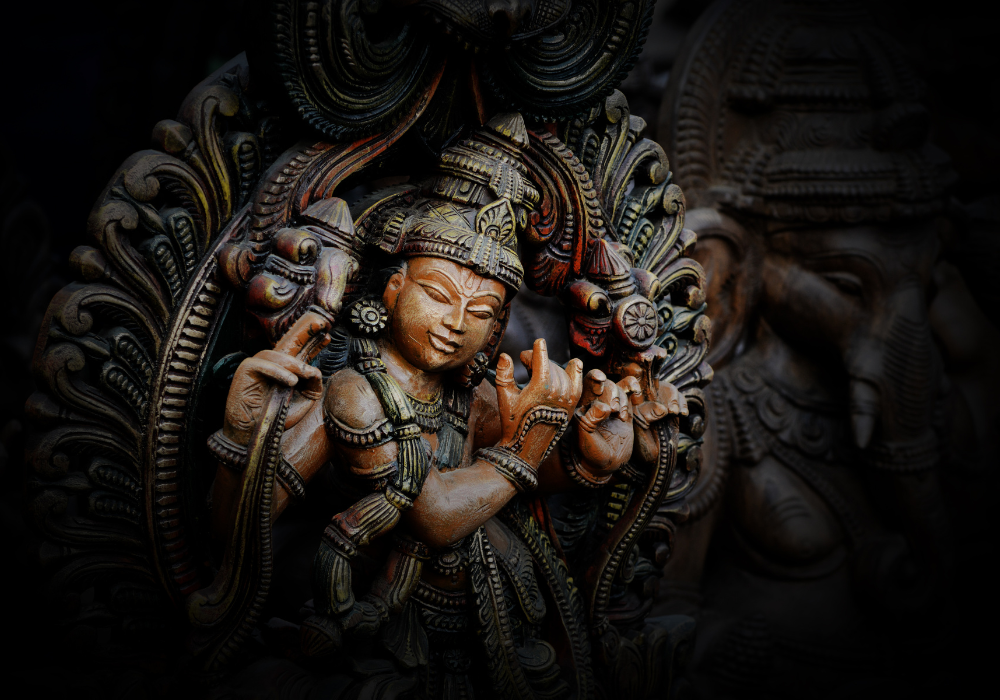
Lord Krishna Tattoo Meaning: The Symbolism Behind the Imagery
Krishna’s iconography is some of the most visually distinct in Hindu tradition. Every element carries meaning. Understanding what you’re including in your design changes the relationship you have with the tattoo.
The Flute (Bansuri)
The flute is Krishna’s most recognizable attribute. The music represents divine consciousness calling the soul toward itself — the sound that draws Radha and the gopis away from ordinary life toward something beyond it. In tattoo form, the flute appears in almost every Krishna design. A standalone flute tattoo is one of the cleaner minimalist options for people who want a Krishna connection without a full portrait.
Peacock Feather (Mor Pankh)
The peacock feather in Krishna’s crown is one of the most iconic symbols in Indian iconography. It represents beauty, grace, and the divine play (leela) of existence. In tattoo form, the peacock feather is versatile — works as a standalone piece, as a crown detail in a portrait, or as a complementary element in a Radha-Krishna composition.
Makhan (Butter) — Bal Krishna
The image of young Krishna stealing butter — Makhan Chor — is one of the most beloved forms in Indian devotion. It represents innocence, mischief, and the idea that the divine doesn’t operate by ordinary rules. As a tattoo, Bal Krishna is among the most emotionally resonant choices, particularly for people who grew up with this imagery.
Sudarshana Chakra
The spinning discus weapon held on Krishna’s finger. Represents cosmic order, the destruction of evil, and divine protection. In tattoo form, the chakra appears most commonly in Vishwaroopa or warrior depictions of Krishna. It’s a strong design element that adds dynamism to any composition.
Radha Krishna
The Radha-Krishna pairing is not simply a love story. It represents the soul’s longing for the divine — Radha as the devotee, Krishna as the object of devotion, the gap between them as the space of spiritual seeking. As a tattoo, Radha-Krishna is one of the most requested couple or devotional designs in India.
Arjuna and Krishna — Bhagavad Gita Scene
Krishna as the charioteer, Arjuna in the chariot, the battlefield of Kurukshetra as the backdrop. This is one of the most philosophically charged images in Hindu tradition — the moment the Gita was spoken. As a tattoo, this is a large-scale composition that requires a skilled artist and significant space. It’s not a wrist tattoo.
Peacock, Cow, Yamuna River
These are supporting symbols — the cow representing abundance and care (Krishna as Govinda, protector of cows), the Yamuna as the sacred river of his childhood, and the peacock as his natural companion. These work as background or supporting elements in larger compositions.
Lord Krishna Tattoo Designs: Forms and Compositions That Work
1. Krishna Portrait Tattoo
A realistic portrait of Krishna — typically showing the flute, peacock feather crown, and the characteristic blue skin tone. This is the most demanding execution in the Krishna tattoo category. The facial expression matters enormously — Krishna’s expression is typically serene and slightly knowing, not fierce. An artist who can capture that subtlety in portraiture is not easy to find.
Black and grey or color? Krishna portraits split here. The blue skin is iconically associated with Krishna, which makes color work a logical choice. However, black and grey portraits done with skill are often more timeless and hold better over years. Both are valid — the choice depends on artist strength and your aesthetic preference.
Best placement: Chest, upper arm, back, thigh.
Style: Black and grey realism, color realism.
Critical factor: Artist’s portrait portfolio. Specifically check for deity work, not just general portraits.
2. Radha Krishna Tattoo
The most requested Krishna design in India. The composition typically shows Krishna playing the flute, Radha beside him, often set against a Vrindavan background — lotus flowers, the Yamuna, or a full moonlit scene.
As a couple tattoo, Radha-Krishna carries cultural depth that generic couple tattoo designs don’t. It’s also a design that works for individuals who connect with the devotional aspect of the imagery — not just couples.
Best placement: Back, chest, upper arm, ribs.
Style: Black and grey realism, illustrative, traditional Indian.
3. Bal Krishna Tattoo (Child Krishna)
Young Krishna — crawling, holding a ball of butter, or dancing. The expression is key: playful, innocent, and alive. This form is particularly meaningful for parents tattooing imagery connected to childhood and joy, or for devotees of the Vallabhacharya or Pushti Marg traditions where Bal Krishna is central.
Best placement: Upper arm, calf, back.
Style: Illustrative, black and grey realism, fine line.
4. Krishna with Flute (Standing/Tribhanga Pose)
The classic standing pose — weight on one hip, flute to the lips, peacock feather in the crown. This is the most compositionally complete single-figure Krishna image. The tribhanga (three-bend) posture gives the figure natural elegance and movement. Works at medium to large scale.
Best placement: Upper arm, calf, back.
Style: Black and grey realism, illustrative, neo-traditional.
5. Bhagavad Gita / Kurukshetra Scene Tattoo
Krishna and Arjuna on the chariot, the battlefield in the background, the moment the Gita begins. This is a full-scene composition — not suitable for small formats. The level of detail required demands an artist with experience in narrative or multi-figure compositions.
Best placement: Full back, chest piece, thigh.
Style: Black and grey realism, illustrative.
6. Vishwaroopa Tattoo
The cosmic form of Krishna — the moment he reveals his universal form to Arjuna. One of the most visually dramatic moments in the Mahabharata. As a tattoo, this is ambitious work. When executed well, it’s extraordinary. It requires both the right artist and significant real estate on the body.
Best placement: Full back, chest to abdomen.
Style: Black and grey realism, illustrative.
7. Minimalist Krishna Tattoos
For people who want a Krishna connection without a full portrait or scene:
- Flute (bansuri) tattoo — standalone, clean, immediately associated with Krishna
- Peacock feather tattoo — elegant, works at small to medium scale
- Om with flute — combines the universal symbol with Krishna’s specific attribute
- Lotus with flute — simple combination, works in fine line
- “Jai Shri Krishna” script — in Devanagari or stylized Sanskrit lettering
These work well as first tattoos, small additions to an existing collection, or for people who prefer subtlety over statement.
Best placement: Wrist, collarbone, inner forearm, ankle, nape.
Style: Fine line, dotwork, minimalist blackwork.
Placement Guide for Krishna Tattoos
| Design | Best Placement | Notes |
| Krishna portrait | Chest, upper arm, back | Needs flat stable surface for facial detail |
| Radha Krishna | Back, chest, upper arm | Composition works best with space |
| Bal Krishna | Upper arm, calf, back | Medium scale works well |
| Tribhanga pose | Upper arm, calf | Vertical composition suits limb placement |
| Kurukshetra scene | Full back, thigh | Large format only |
| Vishwaroopa | Full back | Maximum canvas needed |
| Flute / feather | Wrist, forearm, collarbone | Scales well at small size |
| Script / mantra | Forearm, ribs, collarbone | Flat placement for legibility |
On color placement: If you’re going for a color Krishna portrait, placement matters more than with black and grey. Color tattoos on areas with high sun exposure — forearms, wrists — fade faster. Inner arm, chest, and back retain color significantly better over time.
Tattoo Styles That Work for Krishna
Black and Grey Realism — The strongest choice for portrait and scene work. The tonal depth captures the emotion in Krishna’s imagery. Requires an artist with genuine portraiture skill.
Color Realism — The blue skin makes color portraiture a natural fit. Works best for artists whose portfolios show strong color realism specifically, not just color work in general.
Illustrative / Neo-Traditional — Works well for Radha-Krishna compositions and multi-figure scenes. More forgiving than hyper-realism in terms of artist skill requirement, while still producing striking results.
Dotwork — Particularly effective for standalone symbols — the flute, peacock feather, lotus, chakra. Adds a meditative quality to the work that suits Krishna’s imagery.
Fine Line — Best for minimalist designs. Not recommended for portrait work unless the artist specifically specializes in fine-line portraiture — the facial detail is too complex for standard fine line execution.
Traditional Indian Style — Bold outlines, flat color, stylized representation drawing from miniature painting or calendar art traditions. An interesting choice for people who want the design to reference Indian artistic heritage rather than contemporary realism.
Questions to Ask Your Tattoo Artist for a Krishna Tattoo
- Do you have experience with Hindu deity portraits? Krishna’s expression and posture have specific characteristics. An artist who has done deity work will understand this differently from one who hasn’t.
- Black and grey or color — what’s your stronger suit? For Krishna specifically, this question matters more than for most subjects. Be honest about which you prefer aesthetically, then match it to the artist’s strength.
- What size do you recommend for this design? For portrait and scene work, size is not a stylistic choice — it’s a technical requirement. If your design needs 8 inches to hold detail and you want it at 4, understand what you’re sacrificing.
- Can I see your deity or portrait work specifically? General portfolio quality isn’t enough for this subject. Look for deity work, complex portraiture, and multi-figure compositions if that’s your direction.
- How do you approach the blue skin tone in color work? A nuanced question that a good color realism artist will have a considered answer to.
- What’s the touch-up policy? Detailed portrait work almost always benefits from one touch-up session 6–8 weeks post-heal. Confirm this is part of the arrangement.
Common Mistakes in Krishna Tattoos
Wrong expression on the portrait. Krishna’s expression is serene, knowing, slightly playful — never fierce or aggressive. An artist who doesn’t understand this will default to a generic “intense deity” expression that misses the point entirely. Reference this specifically when briefing your artist.
Ignoring compositional balance in Radha-Krishna. The two figures need to be proportionally and stylistically consistent. If the artist renders one figure more skillfully than the other, the composition fails. Look at how the artist handles multi-figure work.
Going too small on complex scenes. The Kurukshetra scene, Vishwaroopa, or even a detailed Radha-Krishna with background elements cannot be compressed into a 3-inch tattoo. The detail will blur and the composition will be unreadable. Size up or simplify.
Color realism with an artist whose strength is black and grey. A portfolio full of excellent black and grey work does not automatically mean the artist can execute color realism. These are different skill sets. If you want color, find an artist whose portfolio shows strong color work specifically.
Choosing an artist based on cost alone. A Krishna portrait is not a tattoo to bargain-hunt. The facial detail, expression, and compositional complexity require experienced hands. A poorly executed deity tattoo is significantly harder to fix than most other tattoos.
How Much Does a Krishna Tattoo Cost in India
| Type | Approximate Cost |
| Small minimalist (flute, feather, script) | ₹2,000 – ₹5,000 |
| Medium portrait or single figure | ₹8,000 – ₹25,000 |
| Radha Krishna composition | ₹15,000 – ₹50,000 |
| Large scene (Kurukshetra, Vishwaroopa) | ₹40,000 – ₹1,50,000+ |
| Full back piece | ₹80,000 – ₹2,00,000+ |
Pricing varies by city, artist experience, and studio standard. Mumbai, Delhi, Pune, and Bangalore studios with experienced artists in portrait realism will be at the higher end — and that’s where this work should be done.
Aftercare for a Krishna Tattoo
Detailed portrait work needs careful aftercare. The fine lines and tonal gradients in a portrait are the first things to suffer from poor healing.
- Gentle cleaning twice daily with mild soap, clean hands only.
- Fragrance-free moisturizer applied lightly — don’t over-saturate.
- No sun exposure during the healing period — minimum two weeks.
- No swimming, soaking, or heavy sweating for the first 2–3 weeks.
- Let peeling happen naturally — picking at a portrait tattoo damages the detail you paid for.
- Book a touch-up at 6–8 weeks. Portrait work often needs it, and it’s worth doing
Final Thought
A Krishna tattoo is one of the richest subjects in devotional tattoo art. The imagery spans childhood innocence, romantic devotion, philosophical depth, and cosmic scale — depending on which form you choose, you’re working with very different visual and emotional material.
The mistakes that make this go wrong are almost always about execution, not concept. The concept is already strong. Finding the right artist for the specific form you want — and giving the design the size and preparation it deserves — is what determines whether you end up with a piece that genuinely reflects the imagery or a compromise you’ll always look at with reservation.
Take the time. Get the consultation. Look at the portfolio closely. The work is worth doing right.